Curaçao
A hidden gem in the Caribbean.
Located at the crossroads of the Americas, Curaçao combines global accessibility with local stability. As an autonomous country within the Kingdom of the Netherlands since 10 October 2010, the island offers a Dutch-derived civil law framework, a multilingual workforce, and infrastructure built for international business.
With a population of roughly 155,000, the Caribbean guilder (XCG) pegged to the US dollar at 1.79 since 31 March 2025, and a financial sector supervised by the Central Bank of Curaçao and Sint Maarten, the island is a credible base for digital builders and companies expanding across the region.
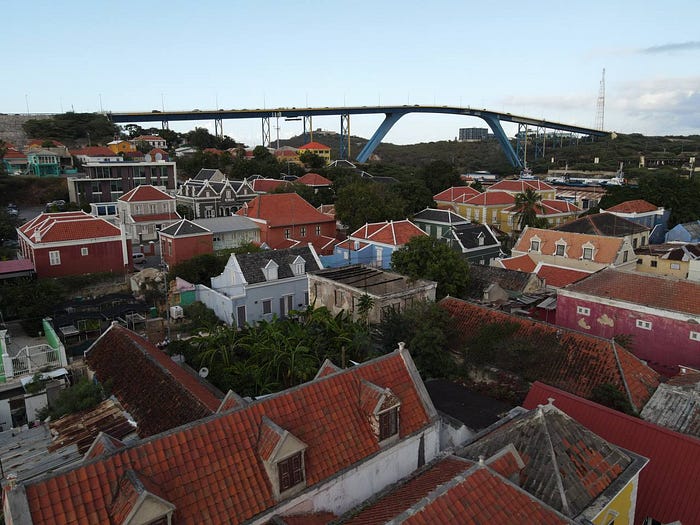
Strategic location
Roughly 65 km off the Venezuelan coast and outside the hurricane belt, with direct air links to Amsterdam, Miami, Bogotá and Panama. One time zone with New York.
Digital infrastructure
Landing point for ARCOS-1, Americas-II and PCCS, with the CELIA and Fénix systems announced. Home to the region’s only Tier IV data centre and a local internet exchange.
Competitive tax framework
Profit tax of 15% on the first XCG 500,000 and 22% above (2024 rates); E-zone exporters pay an effective 2%. Taxation is territorial: foreign costs reduce the real tax burden proportionally, so effective rates are often far lower in practice.
Stable currency
The Caribbean guilder (XCG) replaced the Netherlands Antillean guilder on 31 March 2025, pegged at USD 1 = XCG 1.79 and issued by the CBCS — a peg held (as NAf) since 1971.
Multilingual workforce
Professionals working fluently in Papiamentu, Dutch, English and Spanish — serving clients across Europe, North America and Latin America without translation layers.
Legal & political stability
Part of the Kingdom of the Netherlands, with a civil law system derived from Dutch law and a court of final appeal in the Dutch Supreme Court.
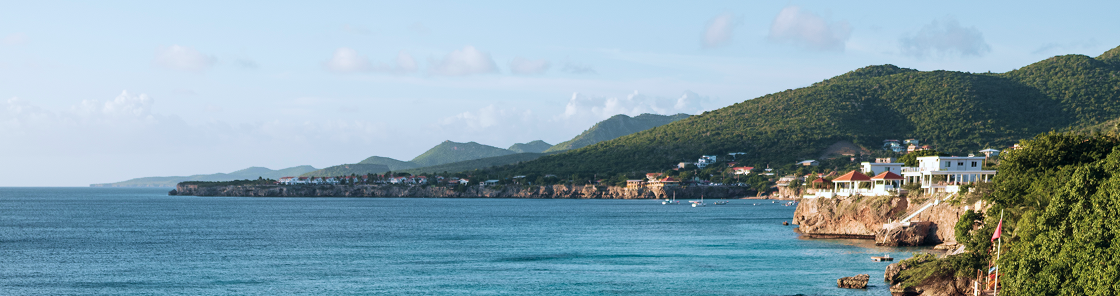
Regulatory landscape
What is in force today
| Framework | Status | In force since | Note |
|---|---|---|---|
| National Ordinance on Games of Chance (LOK) | In force | Q4 2024 | The Curaçao Gaming Authority licenses and supervises directly; crypto sits inside the standard B2C licence rather than a separate regime. |
| Virtual Asset Service Provider (VASP) framework | In force | 4 July 2025 | National Ordinance on the Supervision of Virtual Asset Service Providers (LTVAD), supervised by the CBCS. Licenses crypto businesses — exchanges, custody and other virtual-asset services. |
| CGA crypto policy guideline (B2C licensees) | In force | June 2026 | Guideline under the LOK for licensees accepting crypto; phased compliance to June 2027. Read the summary → |
| PSP / fintech licensing regime | In the works — expected 2027 | — | Payment-service and fintech licensing: expected 2027 (not yet in force). |
Informational. Curaçao does not yet operate a dedicated virtual-asset licensing regime. Structure on the basis of what exists today, not what is expected.